
Cargo Cult Leadership
Copying the behaviors of fast growing companies is dangerous.

If you liked reading this, please click the ❤️ button on this post so more people can discover it on Substack. Thanks!

If you spend time on LinkedIn, you’ll notice that there are a lot of posts about how high-growth AI companies are “changing the rules of business”. These posts highlight something these companies do differently and imply that it’s the cause of their success, and we should all copy them.
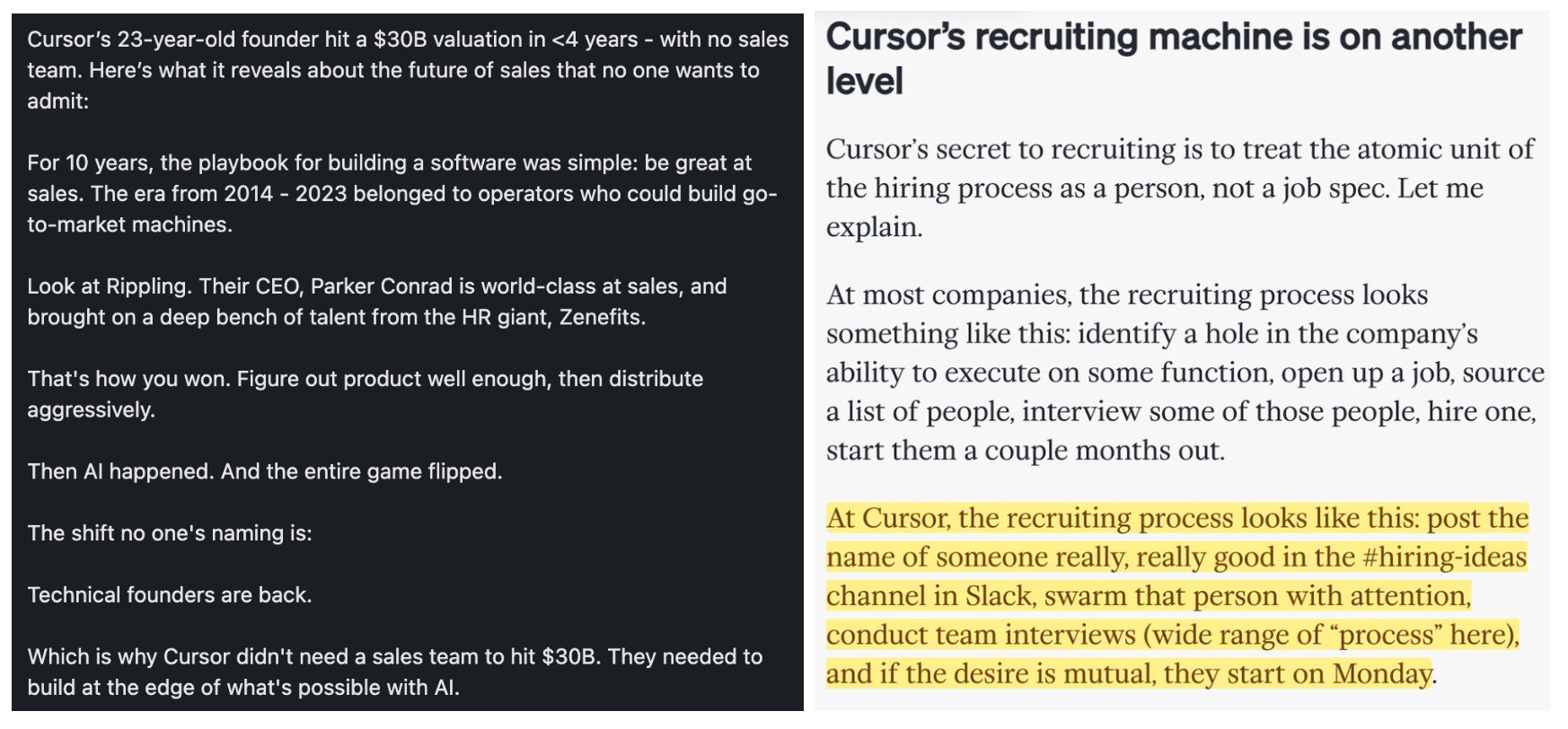
All of these posts fail to understand if the companies are succeeding because of these differences, or in spite of them. Often, it’s in spite of them.
Yes, I know that sounds strange! It is possible to have product-market fit that is so strong that it overcomes even your worst mistakes and leads to incredible growth. We want to believe that success is due to the sum of all the decisions we make, but that’s rarely the case. More often we make one or two great decisions which overcome the remaining bad decisions.
I’m old enough to remember when Medium was a rocketship company and used an entirely new organizational strategy called “holacracy”. At the time, there was a lot of talk about how this would change how companies were run. Later, we all learned that Medium was succeeding in spite of holacracy, not because of it, and eventually it became a liability.
I was lucky to be the founder of a rocketship company myself. At Flurry, we were at the center of the mobile app revolution with the analytics and ads platform used by almost all apps. The platform was growing so fast between 2009 and the acquisition in 2014 that almost all of our work was trying to keep up with it.
I can tell you that many of the things we did were not well thought out, because we frankly didn’t have time. We had to do something to solve a problem, but these happened because of our success not as drivers of that success. If you copied those processes it most definitely wouldn’t have led to success, because they didn’t work without the rocketship beneath them.
Learning from success is possible, but you need a lot of context to do so. Looking at a successful company and copying something they do is dangerous and more likely to hurt than help.
Yes, I know that many of these LinkedIn posts are designed to get attention by being controversial. The LinkedIn algorithm has suppressed organic engagement over the past few years, so users get more and more radical with their posts to try and ignite battles in the comments to boost visibility. That makes some of this even worse, because these people aren’t even following their own advice.
Can you learn anything from rocketship success? Yes! That kind of incredible growth doesn’t happen on its own, and often highlights a structural shift in the market that made that growth possible. But, to learn from it you need deep context to understand what really works. That context exists in real conversations with people working there, not in random posts on the internet.
Be diligent and beware trusting random advice on LinkedIn!
For more on Learning and Strategy, see: