
Focus is a Habit
The only thing harder than focusing is staying focused.

If you liked reading this, please click the ❤️ button on this post so more people can discover it on Substack. Thanks!
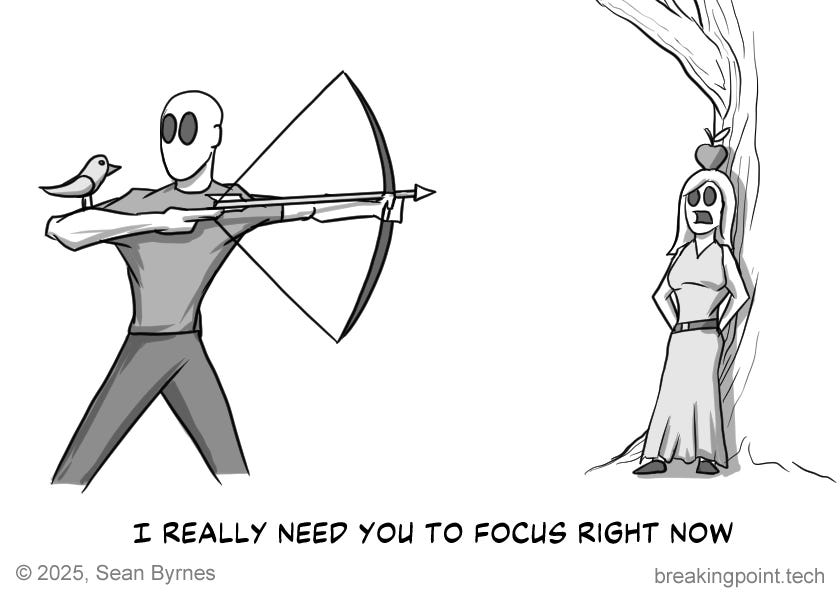
When you are starting a new business, focus is easy. You have no resources, no customers and not a lot of time so you have no choice but to focus. If you don’t focus, the business dies, so you rise to the occasion.
Later, as the business grows, those constraints fall away and you no longer need to be focused. When that opportunity comes, many teams lose their focus. Along the way, they lose their velocity and their competitive advantage while starting to decline.
It’s easy to think of focus as a destination, and when you have it you are done. Unfortunately, that’s not true! The business will change and the definition of focus will change, so hopefully you change with it.
Focus is a habit, not a destination.
Consider your ideal customer profile (ICP). It’s easy to say you are focused on a specific ICP, but what happens when a customer outside your ICP comes along and is desperate for your product? Do you say “no”? Or do you give it a chance? Maybe they represent a new market, or maybe your ICP needs to expand!
Congratulations, you just lost focus. If you do that too many times, you end up with a potpourri of customers with conflicting needs that you struggle to satisfy. You lose velocity because you’re not running in a single direction anymore, and it can kill the business.
Focus does not mean you never change something like your ICP, it means that if you do it’s a conscious decision you make to shift your strategy. Instead of being distracted by the shiny new customer in front of you, you decide if it’s worth committing to that customer group and changing how you work to accommodate them. Focus is intention, and saying “no” to anything outside of your strategy.
It does not come easily! Focus requires you to constantly reinforce until it becomes second nature for you and your team. If you are relentless and ruthless with your focus, soon your team will learn that it’s not worth even considering other distractions. The habit then becomes infectious, and as new people join your team they will inherit the focus.
Take every chance to reiterate your focus:
Remind the team in team meetings and in 1:1s. Repeat what they should be focused on, explicitly, instead of assuming they know. Repetition is the key to reinforcement.
Lead by example, and highlight what you are saying “no” to because it’s not part of the focus. Leaders very rarely talk about their “nos”, but that is exactly where the focus lies.
Praise the folks that demonstrate focus. Often, people are praised when they do something new or novel but that fails to recognize the people who held the line and maintained focus.
Make sure your focus is at the top of everyone’s mind, until it’s a habit and you don’t need to think about it anymore. You’ll know you have achieved it when the team starts saying “no” to you as a leader because something is outside of the focus area. It’s a proud, but difficult moment, when you realize the focus has become clear enough to override your personal opinion as a leader.
And then, if you need to change your focus, talk about it! Tell the team why the focus is changing and what it’s changing into. Focus doesn’t mean you never change, but if you shift focus without being explicit the team will assume you no longer have a focus.
So, pick a focus and make sure your team lives it. You’ll be rewarded with faster growth and a happier team.
For more on Strategy, see: