
Growth is an Ethics Problem
The fastest growth requires you to bend the rules, how far will you go?

If you liked reading this, please share it with someone else. The larger our community, the more time I can spend on these posts. Thanks!
I’m proud that everyone who is a subscriber to The Breaking Point clicked on “Subscribe” themselves at some point. I’m grateful for everyone who has ever read a post, subscribed and especially for all the paid subscribers!
But, that’s not typical for a newsletter. Many newsletters will bulk add people, either based on other kinds of communication, scraping of lists or other sources of contact information. I get a half-dozen of these every week and need to make liberal use of the “Unsubscribe” button.
It’s not illegal to do that, although it is a gray area of the rules. Technically, you aren’t supposed to add someone to your list if they haven’t expressed interest in subscribing. But what does it mean to express interest? Is it enough to visit a website? Is matching the profile of other subscribers enough?
Newsletters certainly grow faster if you bend the rules. Sure, a lot of folks will unsubscribe but some will not. If you keep it up long enough you will build up a large enough audience that you won’t need those tactics anymore! So they are like booster rockets getting you into orbit.
Almost all growth is like this. There are some things that are clearly okay, and others that are clearly not. In between is a large gray area and how far you are willing to push into that gray area shapes your growth strategy.
For example, you don’t want to lie about what your product does. But what if you bend the truth a little? Appeal to some potential customers in ways that are misleading but not technically untrue? What if you talk about a feature that is in development as if it’s done?
Complicating matters is that even if you don’t do it, someone else will. Some of your competitors will push farther into the gray area, and blur the lines more than you. If you change your approach to meet them, someone else will come along that pushes things even further.
To be clear, I’m not criticizing the people who push the envelope in growth! Business is hard, and it’s not surprising people will do whatever it takes to compete. But you have a choice about how far you push things, and that choice determines a lot about your growth strategy.
For example, playing in the gray area leads to short term growth and long term problems. If you bend the truth, you will eventually get caught and it can erode your credibility. Does that matter? Well, that depends. If you rely on word-of-mouth or other high trust channels it can sink your strategy.
Here are some examples of gray area decisions you might need to make:
You want to experiment with a higher price, but that would mean some customers would pay more than others for the same product. Do you tell them? Or do you pretend all customers are paying the higher price?
Customers keep adopting your product because they believe it does something it does not. You haven’t made any false claims, but word is spreading on social media and you can’t control it. Do you get ahead of it and start telling them up front that it doesn’t do what they think? Or let them keep signing up with a mistaken understanding?
You ran a referral contest that ended, but some customers missed the end date and keep referring people believing the contest is still active. Do you tell them their mistake? Or let them keep referring new customers?
There are no right answers! All decisions have pros and cons, and these are no different.
Whatever decision you make, do it purposefully. Set your goals and figure out what strategies are most likely to help you reach them, in both the short term and long. Once you pick a path, don’t waffle! Commit to it and see it through.
There is no scoreboard for business that tracks how you reached success, just whether you found it or not. It’s up to you about what steps you are willing to take to get there.
For more on Growth, see:
"If you change your approach to meet them, someone else will come along that pushes things even further.
"To be clear, I’m not criticizing the people who push the envelope in growth! Business is hard, and it’s not surprising people will do whatever it takes to compete. But you have a choice about how far you push things, and that choice determines a lot about your growth strategy."
Amen to the challenges of growth. And, let's tease out growth actions from growth strategy.
Pragmatism vs Idealism. Never an absolute, what we end up doing is a continuum. Over time however, strategy reveals its component parts: Plan & Character. We think our actions are practical reactions to the vagaries of the marketplace. We are tempted to take liberties to fulfill our Strategy. But is that what we are doing in the moment, or are we practicing moral relativism?
We get in trouble when, under stress, we simplify Strategy to mean a continuous series of wins. That's not Strategy, that's just winning at all costs. Strategy is about taking what "is" to someplace that it isn't yet. Strategy is about sticking to a path, of wins and losses. Literally, strategic thinking means long term effectiveness, not short term convenience, efficiency, or profitability. Does the howling hound of cash flow distract us? Of course. But don't confuse a quick, much needed win with Growth Strategy.
The more you rely upon your Existential goal to explain/rationalize a foray in to the gray, the more you should be reevaluating your Strategy. The easiest and quickest way to get a loaf of bread is to steal your neighbor's. Is that a Growth Strategy, or simply a malign character? Business is not war. If you have to make it so to rationalize your behavior, you've lost the plot of regulated capitalism, agency, and humanity.
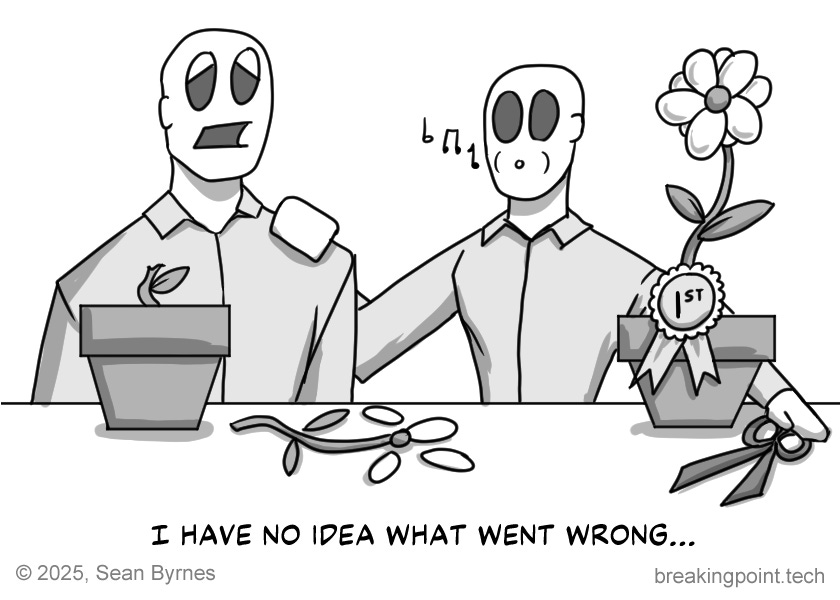
Sean the comic on this was particularly amusing this morning. Thank you for the great laugh and the essay. Kent I especially like the response. So many need "We get in trouble when" paragraph on the wall. Hell just make it in to a comic.