
No Bad News
Bad news is contagious, and you need to get ahead of it.

If you liked reading this, please click the ❤️ button on this post so more people can discover it on Substack. Thanks!
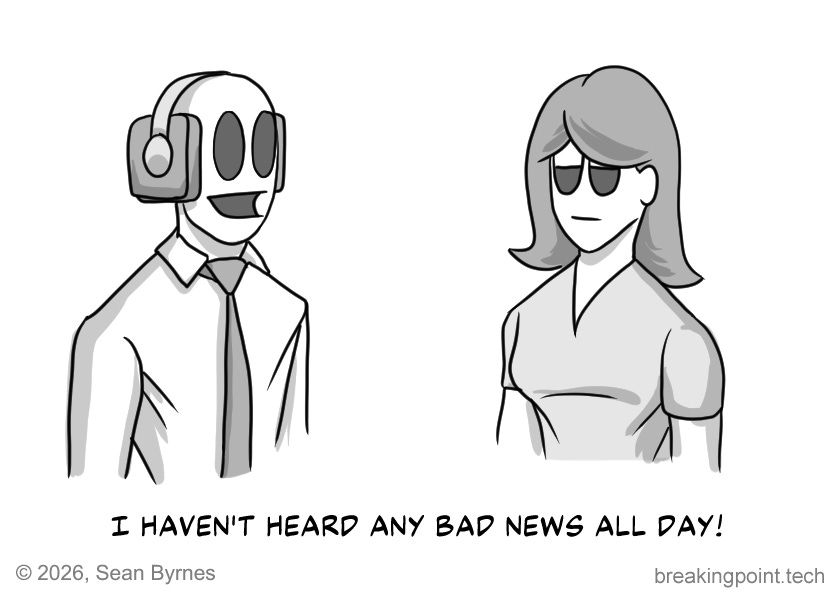
When I was a CEO, I used to joke that I had a “no bad news” policy. No bad news allowed, I only wanted to hear good news! If anyone on the team had bad news, they were to keep it to themselves.
It was, of course, a joke.
But, it was a joke with a purpose. There is always bad news, no matter how well you are doing as a business. The bad news is contagious and spreads further and faster than good news, coloring everyone’s perception of how things are going.
For example, let’s say you have a big customer that decides not to renew. That is bad news! If it starts to spread around the company, everyone might begin to fear the company is struggling. Lost is the fact that the customer is going bankrupt, shutting down and the cancellation has nothing to do with your product and service. All the nuance is lost in the transmission of the bad news.
Then, everyone starts to worry about which other customers might churn. A customer cancels a meeting, and all of a sudden people jump to conclusions. Pretty soon, a dark cloud hovers over the team as bad news has shaped their view of everything.
Negativity bias is a phenomena where people give more weight to bad news as compared to equivalent good news. It makes sense from an evolutionary perspective, as survival was paramount and bad news was more likely to kill early humans. Today, however, it means we have to be careful with bad news.
This doesn’t mean you should hide bad news! Being transparent with your team is critical for building trust, and nothing destroys trust faster than trying (and failing) to hide bad news.
So, what do you do?
Here’s a formula for a real policy around bad news:
Be Public. Share bad news in a public forum. If you don’t, rumor mills and informal paths will be created to share the news. These paths will make things worse by creating a game of telephone where the bad news evolves and shifts every time it’s shared.
Provide Context. If there is bad news, communicate it along with the context necessary to understand it. A customer churned? Explain why and what is being done to make sure that it doesn’t happen again (if possible). Treat your team like adults by educating them.
Emphasis Good News. To overcome negativity bias, you need to emphasize and reinforce good news. Share it multiple times, with the context, so the team understands why the news is so good. The more they listen to good news, the more ready they will be to absorb bad news.
These seem easy to do, but they require you to trust your team. Not all leaders have that trust, and they worry too much about how their team will react to bad news.
As soon as you start to control the flow of information in fear of how your team will react, you are no longer running the company. The team is running it. You need to overcome that fear and have faith they will understand with the right context and communication.
One of my biggest weaknesses as a CEO was always focusing on the next problem. I didn’t celebrate wins enough, as I immediately moved on. I learned the hard way that doing so makes it harder for the team to absorb bad news, as they discount the good news.
So, celebrate your wins! Share good news! And, when bad news arrives, share that too. Your team will be ready for it.
For more on Managing People, see:
Thank you for the great article. Always focusing on the next thing is a good trait in general. It is interesting that it is sometimes not the case for people running a team or company.