
Not Everything is an Emergency
If you are constantly fighting emergencies, you don’t have emergencies.

If you liked reading this, please click the ❤️ button on this post so more people can discover it on Substack. Thanks!
Every company has emergencies. Things go horribly wrong at the worst moment and you need to mobilize the entire team to try and handle the situation. Maybe your biggest customer is churning and a team jumps on a plane to try and meet with them. Or maybe your systems are down and engineering is working around the clock to figure out why and bring them back. Emergencies happen.
Emergencies force everyone to align, as they provide focus and clarity. All that matters is resolving the emergency and any bad processes, politics or other organization issues are thrown aside. In an emergency the organization becomes the best version of itself.
Unfortunately, eventually, companies figure out that emergencies become an alternative to the normal operating procedure. If the company is dysfunctional, the best way to get things done is to have an emergency. Or, the company is so dysfunctional that emergencies happen all the time because they are the only way things get done.
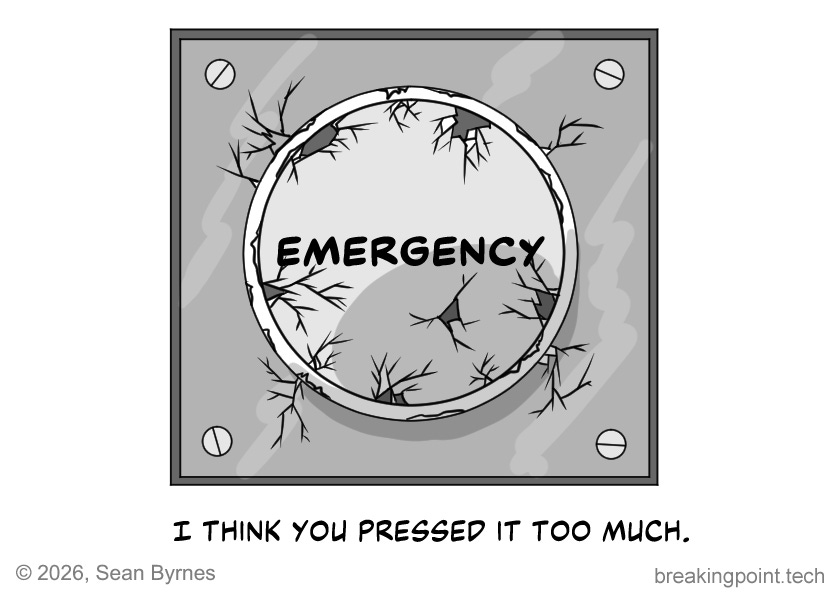
In these companies, emergencies are constantly happening because it’s the only way the company knows how to operate. Instead of having an “emergency” button that you can press, someone puts a brick on top of the button to hold it down.
These companies are not doing well.
You can understand how it happens. Fixing organizational, process and people problems are hard and time consuming. Once you realize that pressing the emergency button makes those problems fade into the background, it’s easier to keep pressing it than to fix the problems.
Sadly, constantly being in emergency mode comes at a cost. There is no time for long-term thinking in an emergency, everything is about short term survival. Emergencies do not build up repeatable good habits, so very little institutional knowledge is developed. Eventually, people become desensitized to emergencies and treat them with less and less urgency.
If you feel like your organization is treating emergencies as the normal course of business, it’s time to hit reset. You need to take a step back and get out of that cycle. Here are a few ways to do that:
Have an emergency team. Emergencies can, in theory, suck in anyone and everyone in your team. That is dangerous if emergencies keep happening, as everyone starts to brace for the next emergency! Designate a specific team to deal with emergencies so that everyone else knows they need to focus on fixing the real problems in the organization. It minimizes distractions and aligns incentives.
Hold post-mortems. Don’t let an emergency go to waste! Hold post-mortem meetings to analyze what went wrong and how you can prevent it from happening again. Commit to executing on at least 1-2 action items from that analysis immediately so the team sees real change happening from an emergency.
Track emergencies. It sounds depressing to have “number of emergencies” as a metric, but it’s important! People are good at optimizing metrics, and if you have a metric for it then it provides a scoreboard to track any improvements you make. It should be zero, but it won’t start out that way.
The key to getting out of the constant emergency trap is to give the team incentives to prevent emergencies, not just to resolve them. Giving them space and time is great, but if the incentives are not clear you won’t see any real progress.
You will know you have made progress when you start to see people tackling the hard work of fixing organizational problems. That is much harder than hitting the emergency button, and it means you have the right incentives and priorities.
Emergencies should be rare. To make sure that is true, get ahead of the problem and make sure emergencies aren’t better than normal operations in your business.
For more on Managing People, see: