

If you liked reading this, please click the ❤️ button on this post so more people can discover it on Substack. Thanks!
I’ve been an artist most of my life, and I’m happy to report that I have (a few times) actually been paid for my art. As someone who does art as a hobby, that is a big deal!
However, I need to be honest that the drawing I was paid the most for wasn’t one of the pieces I spent a long time on that channeled my artistic vision. It wasn’t even one of the pieces I’m most proud of. It was this diagram:
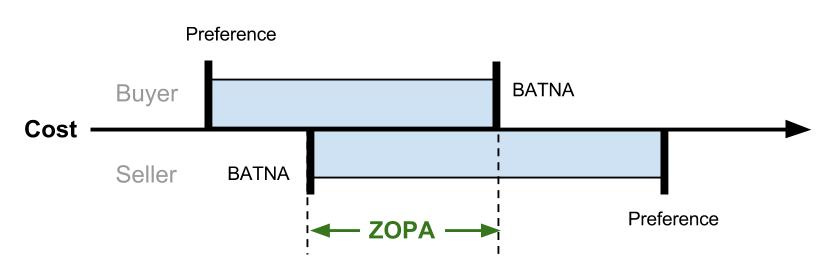
Apparently this is art that pays
It’s from a blog post I wrote, many years ago, about negotiation and I might have spent a total of 2 minutes making it. If you’re familiar with negotiation, there is no shortage of diagrams and explanations of BATNA, ZOPA, etc. On the surface there doesn’t seem to be anything special about this one.
So, I was shocked when I was contacted by a publishing company eager to license it for more money than I would have thought to ask. I assumed publishing companies had plenty of graphic designers to hire to create such diagrams, especially for what I was told was a textbook. Why would they want to pay me so much?
I later found out that the author had put this diagram in the book and they had not caught the copyright violation early enough. It was already in the book, so they needed to pay me enough to ensure a license! It turns out that image was valuable not because of its quality, but because of the circumstances.
This is a key to negotiation. The other side has motivations that drive their negotiation strategy and leverage, things that might not be obvious on the surface. A customer that is trying to drive down your price might have a tight budget, or they might be trying to get promoted by showing how hard they are on vendors. An employee asking for a raise might want to get paid more, or they might have a job offer from someone else.
If you can tease out the hidden motivations for the other side, or at least infer that one exists, you can find much more leverage. In some cases, you might have all the leverage!
Let’s say you are selling your company to a large conglomerate. It might seem like they have a lot of options and most of the leverage in negotiating a deal, and that might be true. However, the executive that is sponsoring your deal might have a mandate to make an acquisition happen as part of their annual plan. If that is true, and it’s the end of the year, they might need the deal more than you do.
How do you find hidden motivations? Insert friction into the negotiation. If you have very little leverage, your instinct might be to remove friction and try to create a clear path for the deal to close. Introducing a bit of friction is an important test to see if there are hidden motivations, since if they are, the other side will leap to remove the friction. If not, well, you can always remove it yourself.
Of course, there are not always hidden motivations. Sometimes all the leverage is on the table and you need to play the hand you’re dealt. In the vast majority of negotiations I’ve done there are no hidden motivations and what you see is what you get.
But in a few, they have helped me get a lot more than I could have hoped going in!
Next time you’re going into a negotiation with very little leverage, be patient and observant. Look for signs that you might have more leverage than you think, and if you do lean into it!
For more on Strategy, see:
This is a really fun story, and it's cool to see they tracked you down to ensure appropriate credit & compensation
dude
you have to make an extended version of this
I want to read more